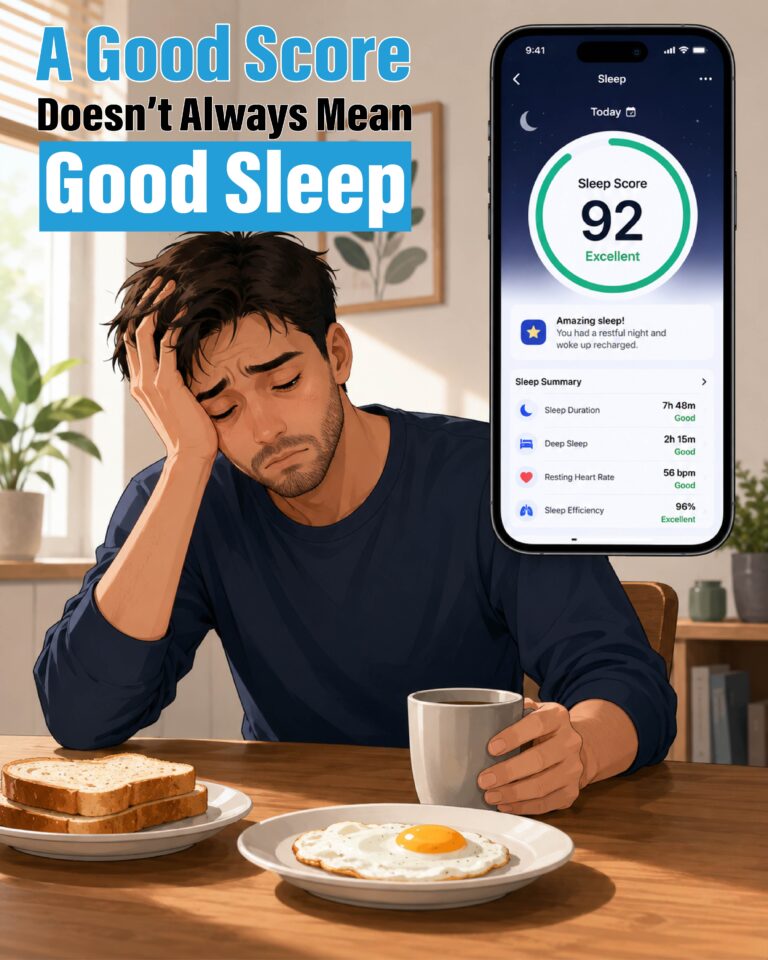
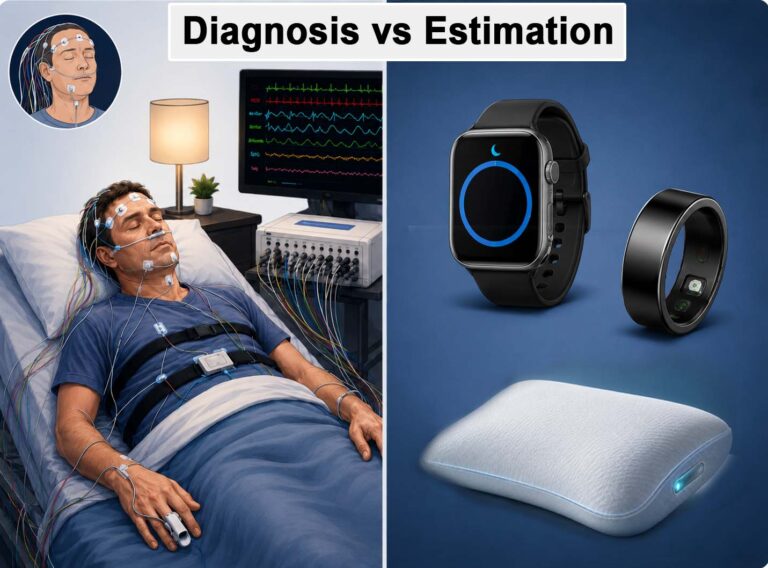
Sleep tracking is one of the fastest-growing wellness trends of our time. What used to involve spending an entire night in a sleep lab hooked up to wires and monitors to get an idea of how much you slept overnight is now something you can do easily with smart consumer gadgets. These could be wearables like smartwatch on your wrist, a ring on your finger, or nearables like smart mattress or pillows. These gadgets put output about the quantity and quality of sleep as a number called sleep score. Every morning, people wake up and almost automatically glance at their sleep score before they even stop to ask a more important question: How do I actually feel?
Clearly, the growing prevalence of sleep tracking has people thinking more about sleep health, but at what cost? Are we measuring sleep, or do we really understand it? The far deeper problem is that we measure and talk about sleep without understanding its implications.
What Sleep Tracking Really Means
The Rise of DIY Sleep Tracking
At the most simple level, sleep tracking is the application of technology to answer the question, what happens while you are asleep? Sleep tracking devices try to answer this by analyzing data collected overnight. What initially piques consumer interest is them being able to easily self-administer the device, as opposed to traditional medical diagnostic sleep devices which require prescription. What starts as a general question to answer, Am I sleeping ‘enough’?, can then spiral to self-competition by tracking and comparing sleep data. Measuring and tracking your sleep are only the beginning. What many people do not consider is the recently changing discussions around sleep.
How Consumer Sleep Trackers Actually Work
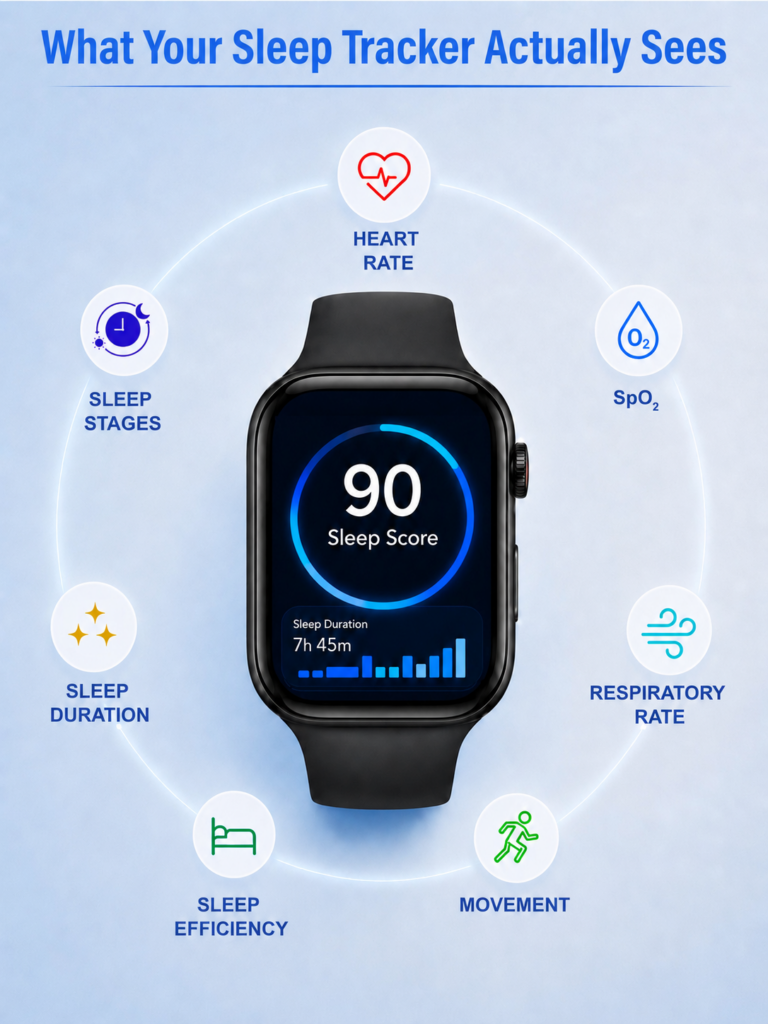
Sleep tracking devices collect data on movements, heart rate, breathing, and blood oxygen, etc., which are then put into the output of total sleep, sleep stages, and sleep score to name a few. The type of data measured by different consumer sleep tracking devices varies and so does the accuracy of the output.
Movement
Accelerometers are the primary form of movement trackers found in most consumer sleep devices. When an accelerometer detects minimal movement, sleep is assumed; on the other hand, higher levels of movement are interpreted as wakefulness. While this theory works for the most part, it has one giant flaw. Without EEG, eye movement and EMG measurement, a person can be fully awake and simply still in bed, and a consumer sleep tracker can record this as the person being asleep.
Heart Rate, Temperature and Sleep Stages
More advanced consumer sleep trackers in most cases incorporate heart rate, temperature, and oxygen data to help improve the accuracy of its estimations. These light-based sensors enhance the tracker's overall accuracy in guessing which stage of sleep a person is likely in.
Proprietary Algorithms and Their Blind Spots
The data that is collected by consumer sleep trackers is analyzed through an algorithm, and most of the time this algorithm does not provide any transparency as to how it was developed and is usually inaccessible, this phenomenon is called Blackbox, meaning the user and clinicians can’t understand how the output is reached. That is why two devices can analyze the very same night and produce two extremely different snapshots of sleep. Though sleep trackers are becoming increasingly sophisticated, in the end, Consumer sleep trackers only give rough estimates.
How Accurate Are Consumer Sleep Trackers?
The accuracy of consumer sleep trackers does not compare to the accuracy of in-lab sleep studies called polysomnogram, as consumer sleep trackers work based on estimations rather than fact.
Strong for Basics, Weak for Details
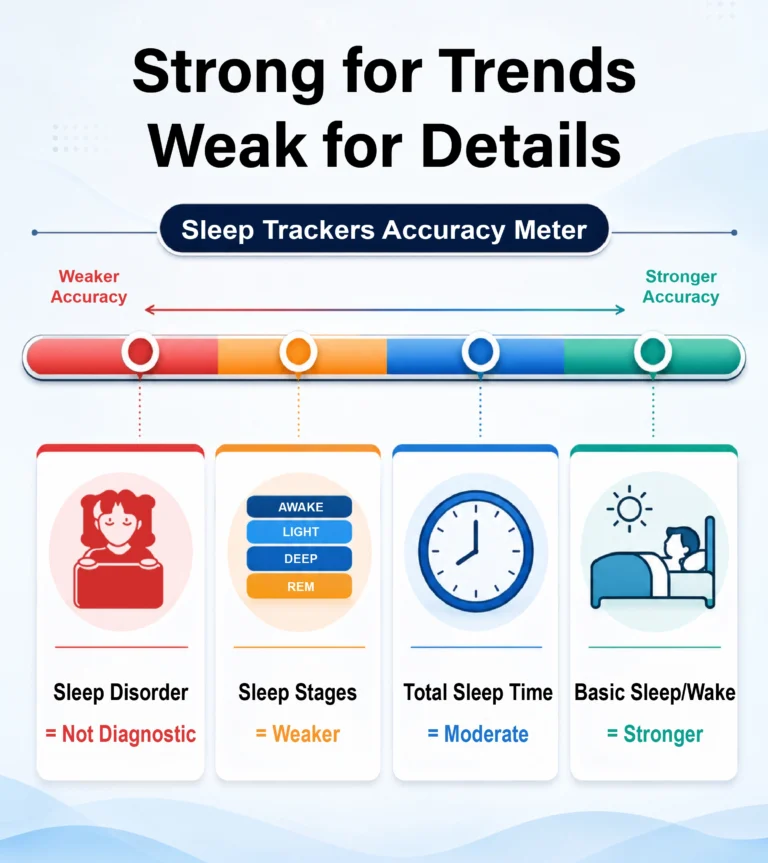
Of all the functions that sleep trackers are able to do, the basic sleep detection of whether you are asleep or awake is the most accurate. Studies suggest that consumer wearables are able to detect sleep throughout the night with over 90% accuracy, and detection of total sleep time is also within reasonable error.
For questions that don’t require detailed analyses, the sleep tracker can give you a lot of valuable information, like the total time you slept and your bedtime. But once you ask questions that demand higher accuracy, the results become unreliable.
Sleep Stage Accuracy Is Unreliable
Sleep stage tracking (light, deep, REM) can be anywhere from 50% to 80% accurate depending on the brand of the device and sleep conditions. Nightly awakenings are also underestimated. In practical terms, consumer wearables can say that you are sleeping well, even when you are experiencing the exact opposite.
Can Consumer Sleep Trackers Diagnose a Sleep Disorder?
The Short Answer: NO
A common question is whether a consumer sleep tracker can actually diagnose a sleep disorder. The short answer is no. According to the American Academy of Sleep Medicine, consumer sleep trackers should not be used to diagnose sleep disorders. These devices are considered wellness tools. Sleep trackers are not FDA-cleared as medical devices and cannot be used for diagnosis of sleep disorders. Some newer devices can, however, flag possible warning signs. For example, the Apple Watch Series 10 or above has a Breathing Disturbance feature, and the Samsung Galaxy Watch has an FDA-authorized sleep apnea feature. They can serve as screening tools for sleep apnea. They may help identify people at risk for moderate-to-severe sleep apnea, but they miss up to 1/3rd of mild cases of sleep apnea and can produce false positives or false negatives.
What Consumer Sleep Trackers Often Miss
The Hidden Gaps in the Data
Overestimating Sleep
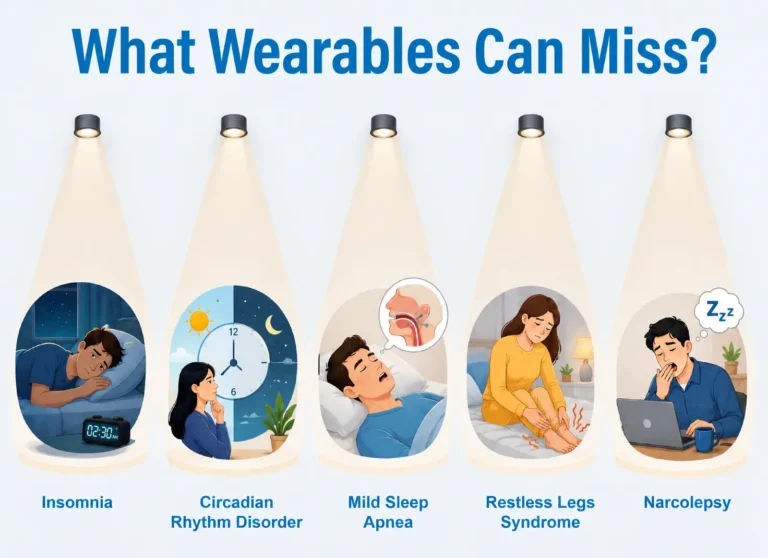
For individuals with insomnia, trackers may overestimate sleep. Because when the person is lying still, the device assumes they are asleep—even when they are awake for long periods. This can create a misleading picture of "good sleep" despite ongoing struggle.
Misrepresenting Circadian Rhythm Disorders
Circadian rhythm disorders present another blind spot. Someone may have a highly irregular sleep schedule—going to bed very late or shifting patterns on weekends—yet still receive a "good" score because total sleep time appears adequate.
Wearables May Miss Some Sleep Disorders
Moreover, many sleep disorders like mild sleep apnea, narcolepsy, restless legs syndrome, etc are completely untrackable via wearables. Proper diagnosis requires a mandatory clinical assessment by a qualified sleep clinician.
The implication is profound: a good sleep score does not guarantee good sleep.
The Downsides: When Tracking Becomes a Problem
From Awareness to Anxiety: Orthosomnia
While consumer sleep trackers are designed to help, they can sometimes do the opposite. One major risk is false reassurance. A person may have fragmented or poor-quality sleep, but their device reports a high score. This can delay medical evaluation and prolong underlying issues. On the other hand, trackers can also create unnecessary anxiety. Users may become overly focused on numbers, feeling stressed when scores dip—even if they feel well-rested. Over time, this can evolve into a condition known as Orthosomnia, where the pursuit of “perfect sleep data” actually worsens sleep quality. There is also a subtle but important psychological shift. Sleep, once an intuitive experience, becomes externalized—defined by a number rather than a feeling. This disconnect can erode trust in one’s own body.
When Are Consumer Sleep Trackers Actually Useful?
Despite their limitations, consumer sleep trackers can be powerful tools when used correctly. Their greatest strength lies not in precision, but in patterns.
1. Spotting Trends Over Time
Using a consumer sleep tracker for multiple nights is more valuable than a single night. Because when sleep is measured longitudinally over a period of weeks or months it yields valuable insights into sleep patterns. Research suggests that multiple nights of data are needed to estimate true sleep behavior and to suggest actionable tips.
2. Understanding Habit Impact
Changes in routine—late nights, travel, stress, alcohol—often show up clearly in sleep data. This allows users to connect behaviors with outcomes in a tangible way.
3. Monitoring Consistency
Regular sleep timing is one of the strongest predictors of overall sleep health. Trackers can highlight variability in bedtime and wake time, helping users stabilize their routines.
4. Supporting Clinical Conversations
While not diagnostic, sleep data can provide valuable context during medical visits. Patterns over time can help clinicians better understand a patient’s experience.
5. Increasing Awareness
Sometimes, the greatest benefit is simply awareness. Tracking sleep makes it visible—and what becomes visible often becomes actionable.
When to Stop Trusting the Device
Symptoms Always Come First
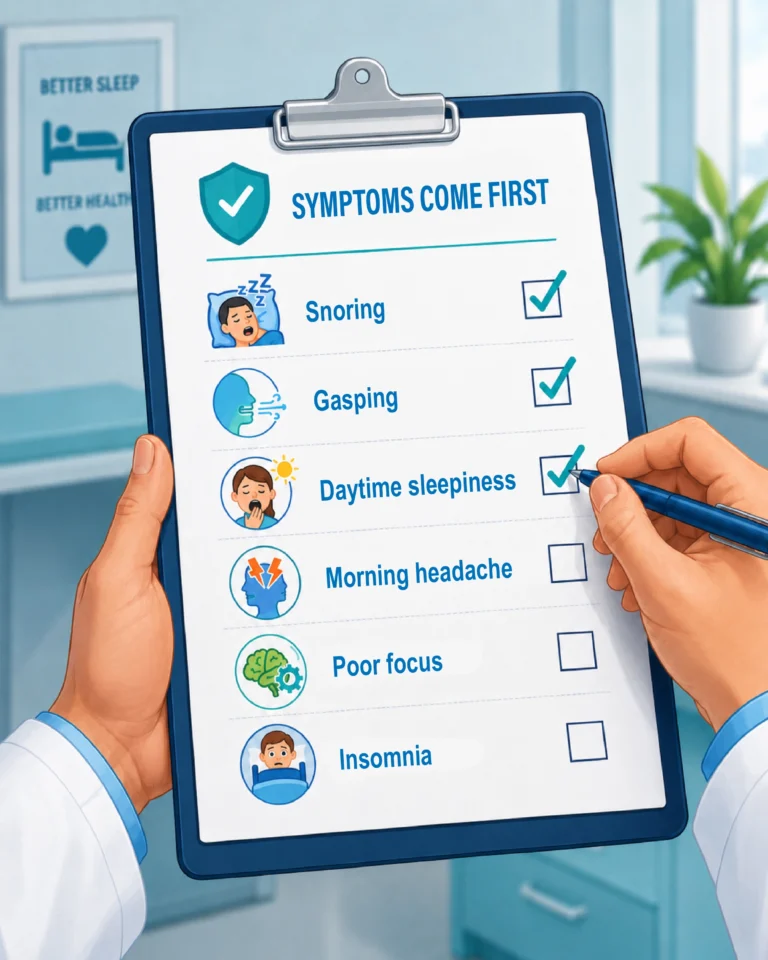
There is a critical point where data should take a back seat to experience. If you consistently feel tired, unrefreshed, or cognitively impaired—despite “good” sleep scores—it is time to look beyond the device. Certain warning signs should never be ignored:
Loud, persistent snoring
Choking or gasping during sleep
Daytime sleepiness despite adequate time in bed
Morning headaches
Difficulty falling or staying asleep
Memory or concentration issues
These symptoms are strongly associated with sleep disorders and require proper medical evaluation. The rule is simple: trust your body more than your tracker.
How to Use a Sleep Tracker Wisely: A Practical Framework
To get real value from your device—without falling into its traps—follow these principles:
Focus on trends, not perfection: One night means nothing. Patterns mean everything.
Prioritize how you feel: Your daytime energy matters more than your sleep score.
Avoid self-diagnosis: Trackers are guides, not medical tools.
Never ignore symptoms: A “good score” does not override real warning signs.
Use data to improve habits: Consistent sleep timing, reduced caffeine, limited alcohol, and better screen habits matter far more than any metric.
Share data with a clinician when needed: Use it as context—not as a conclusion.
The Bottom Line
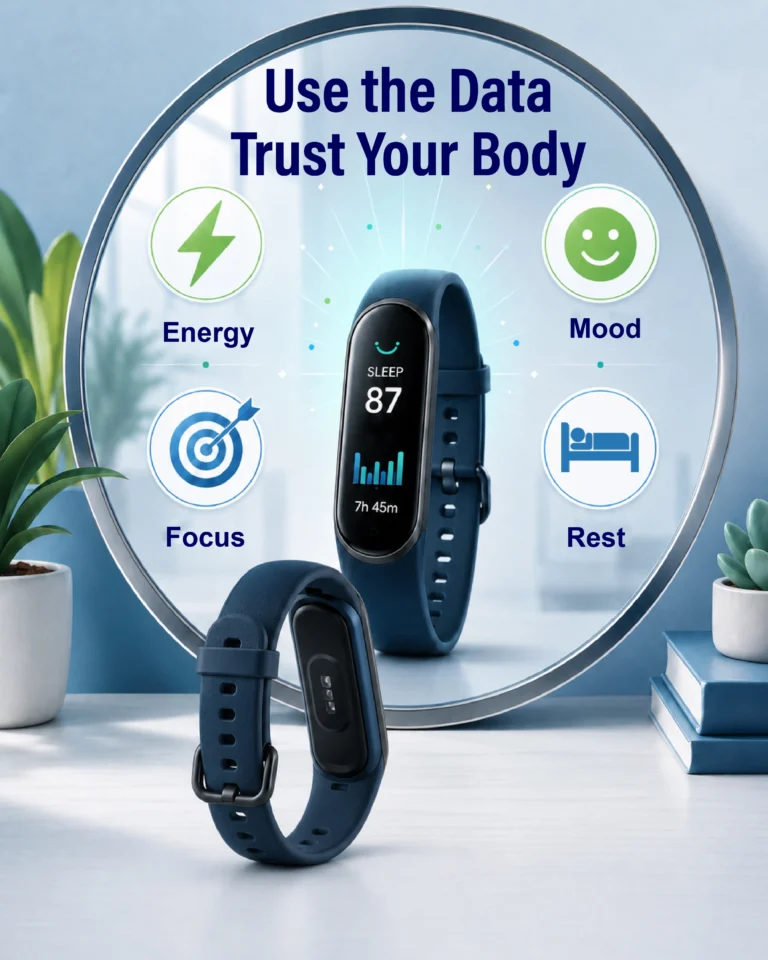
In summary, a sleep tracker is a mirror. It reflects patterns. It highlights trends. But it does not tell the whole story. Consumer sleep trackers have transformed how we engage with sleep. They have made the invisible visible, bringing awareness to a part of health that was long overlooked. That is their greatest achievement. But they are not machines of truth. They estimate. They simplify. They sometimes mislead. The most important insight is not hidden in an algorithm—it is something you already have. Your energy. Your focus. Your mood. Your sense of rest. So use the data. Learn from it. Let it guide you. But don’t mistake it as a replacement for your doctor.
Disclaimer
This is an educational blog and not medical advice. If you or your loved ones suffer from sleep issues, call Telemedora at 650-687-7368 or visit telemedora.com to find out how we can help you. Whether it's sleep apnea, insomnia, or just restless nights, Telemedora brings expert care directly to your home. We help patients get the rest they need so they can wake up refreshed, focused, and ready to crush their goals for the next day.